> For the complete documentation index, see [llms.txt](https://developer.supervisely.com/llms.txt). Markdown versions of documentation pages are available by appending `.md` to page URLs; this page is available as [Markdown](https://developer.supervisely.com/app-development/widgets/compare-data/matchdatasets.md).
# MatchDatasets
## Introduction
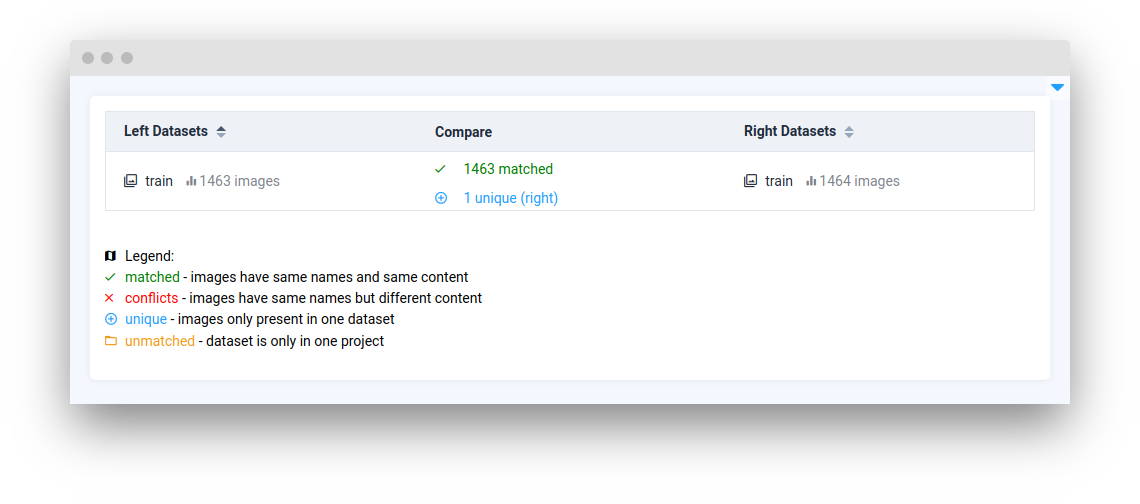
**`MatchDatasets`** widget in Supervisely allows users to compare datasets by matching objects and displaying the results in a table. It also provides the comparison results in the form of a dictionary grouped into `matched`, `unique_left`, and `unique_right` categories. This widget helps users identify differences and similarities between datasets quickly and efficiently.
## Function signature
```python
MatchDatasets(
left_datasets=None,
right_datasets=None,
left_name=None,
right_name=None,
widget_id=None,
)
```
## Parameters
| Parameters | Type | Description |
| :--------------: | :-----------------: | :---------------------------------------------------------------: |
| `left_datasets` | `List[DatasetInfo]` | List of `NamedTuple`, containing information about left datasets |
| `right_datasets` | `List[DatasetInfo]` | List of `NamedTuple`, containing information about right datasets |
| `left_name` | `str` | Left part datasets name |
| `right_name` | `str` | Right part datasets name |
| `widget_id` | `str` | ID of the widget |
### left\_datasets
Determine information about left datasets.
**type:** `List[DatasetInfo]`
**default value:** `None`
### right\_datasets
Determine information about right datasets.
**type:** `List[DatasetInfo]`
**default value:** `None`
```python
dataset_left_id = 55830
dataset_left = api.dataset.get_info_by_id(id=dataset_left_id)
dataset_right_id = 55826
dataset_right = api.dataset.get_info_by_id(id=dataset_right_id)
match_datasets = MatchDatasets(left_datasets=[dataset_left], right_datasets=[dataset_right])
```
### left\_name
Determine left part datasets name.
**type:** `str`
**default value:** `None`
### right\_name
Determine right part datasets name.
**type:** `str`
**default value:** `None`
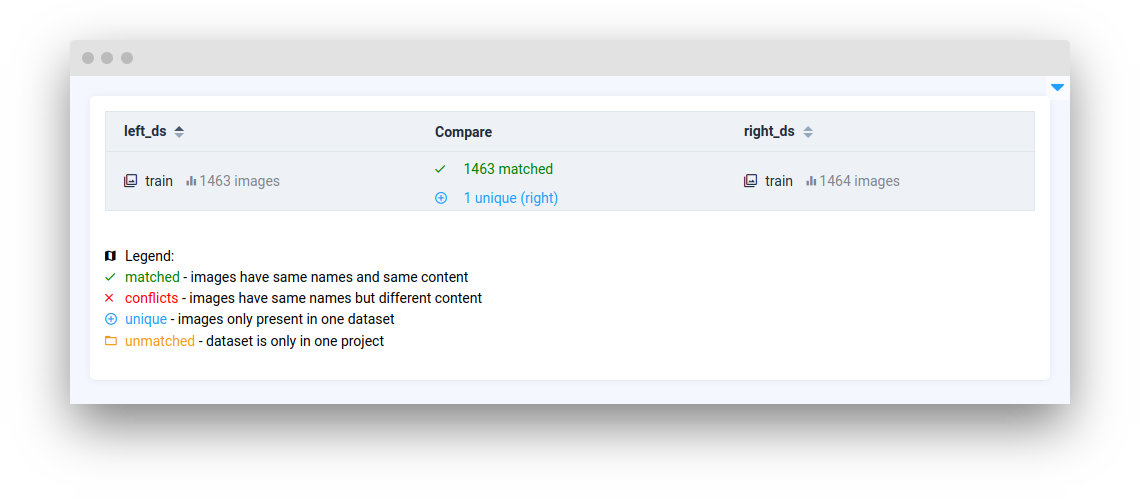
```python
match_datasets = MatchDatasets(
left_datasets=[dataset_left],
right_datasets=[dataset_right],
left_name="left_ds",
right_name="right_ds",
)
```
### widget\_id
ID of the widget.
**type:** `str`
**default value:** `None`
## Methods and attributes
| Attributes and Methods | Description |
| :-----------------------------------------------------------------------------------------------------------------------: | -------------------------------------------------------- |
| `set(left_datasets: List[DatasetInfo] = None, right_datasets: List[DatasetInfo] = None, left_name=None, right_name=None)` | Set `DatasetInfo` data in left and right part of widget. |
| `get_stat()` | Return datasets match statistics. |
## Mini App Example
You can find this example in our Github repository:
[ui-widgets-demos/compare data/001\_match\_datasets/src/main.py](https://github.com/supervisely-ecosystem/ui-widgets-demos/blob/master/compare%20data/001_match_datasets/src/main.py)
### Import libraries
```python
import os
import supervisely as sly
from supervisely.app.widgets import Card, Container, MatchDatasets
from dotenv import load_dotenv
```
### Init API client
First, we load environment variables with credentials and init API for communicating with Supervisely Instance:
```python
load_dotenv("local.env")
load_dotenv(os.path.expanduser("~/supervisely.env"))
api = sly.Api()
```
### Prepare datasets we will matched
```python
project_id1 = 17198
project_id2 = 17199
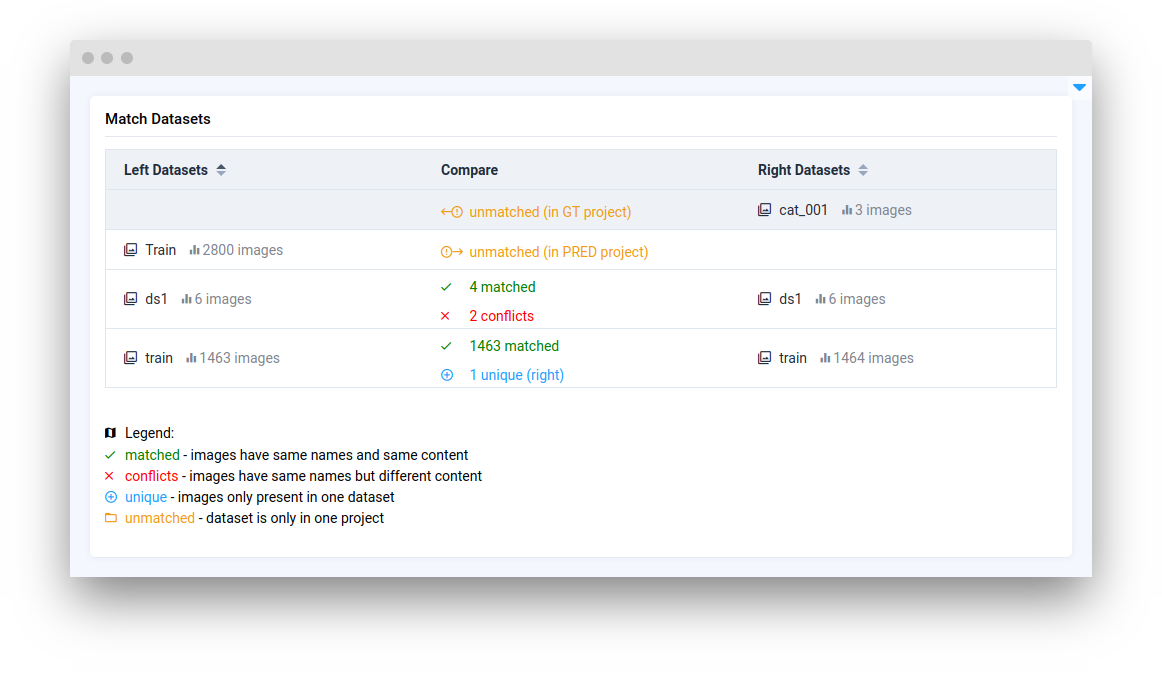
datasets_left = api.dataset.get_list(project_id1)
datasets_right = api.dataset.get_list(project_id2)
```
### Initialize `MatchDatasets` widget
```python
match_datasets = MatchDatasets(
left_datasets=datasets_left,
right_datasets=datasets_right,
)
```
### Create app layout
Prepare a layout for app using `Card` widget with the `content` parameter and place widget that we've just created in the `Container` widget.
```python
card = Card(
title="Match Datasets",
content=match_datasets,
)
layout = Container(widgets=[card])
```
### Create app using layout
Create an app object with layout parameter.
```python
app = sly.Application(layout=layout)
```