> For the complete documentation index, see [llms.txt](https://developer.supervisely.com/llms.txt). Markdown versions of documentation pages are available by appending `.md` to page URLs; this page is available as [Markdown](https://developer.supervisely.com/app-development/widgets/controls/radiogroup.md).
# RadioGroup
## Introduction
**`RadioGroup`** widget in Supervisely is a user interface element that allows users to create a group of mutually exclusive options that can be selected via radio buttons. With the RadioGroup widget, users can define a set of options, each with a corresponding radio button, and only one option (**`RadioGroup.Item`**) can be selected at a time. Overall, **`RadioGroup`** widget is a valuable tool for simplifying user interactions and improving the usability of Supervisely apps.
## Function signature
```python
RadioGroup(
items, size=None,
direction="horizontal",
gap=10,
widget_id=None,
)
```
## Parameters
| Parameters | Type | Description |
| :---------: | :---------------------------------------: | :----------------------------: |
| `items` | `List[RadioGroup.Item]` | List of `RadioGroup` content |
| `size` | `Literal["large", "small", "mini", None]` | `RadioGroup` size |
| `direction` | `Literal["vertical", "horizontal"]` | `RadioGroup` items direction |
| `gap` | `int` | Gap between `RadioGroup` items |
| `widget_id` | `str` | ID of the widget |
### items
Determine list of `RadioGroup` items.
**type:** `List[RadioGroup.Item]`
### size
Determine `RadioGroup` size.
**type:** `Literal["large", "small", "mini", None]`
**default value:** `None`
```python
radio_group = RadioGroup(items=items, size="large")
```
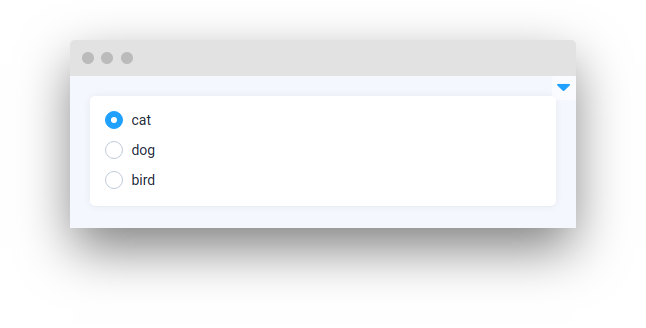
### direction
Determine `RadioGroup` items direction.
**type:** `Literal["vertical", "horizontal"]`
**default value:** `horizontal`
```python
items = [
RadioGroup.Item(value="cat"),
RadioGroup.Item(value="dog"),
RadioGroup.Item(value="bird"),
]
radio_group = RadioGroup(items=items, direction="vertical")
```
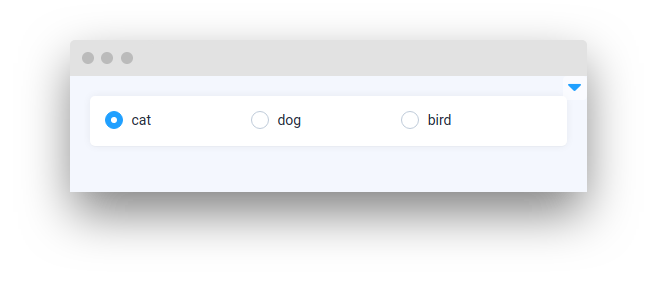
### gap
Determine gap between `RadioGroup` items.
**type:** `int`
**default value:** `10`
```python
items = [
RadioGroup.Item(value="cat"),
RadioGroup.Item(value="dog"),
RadioGroup.Item(value="bird"),
]
radio_group = RadioGroup(items=items, gap=100)
```
### widget\_id
ID of the widget.
**type:** `str`
**default value:** `None`
## Methods and attributes
| Attributes and Methods | Description |
| :---------------------------------: | ----------------------------------------------------------------- |
| `get_value()` | Return selected `RadioGroup.Item` value. |
| `set(items: List[RadioGroup.Item])` | Set given list of `RadioGroup.Item` in `RadioGroup`. |
| `set_value(value: str)` | Set given value by value of `RadioGroup.Item`. |
| `@value_changed` | Decorator function is handled when input `RadioGroup` is changed. |
## Mini App Example
You can find this example in our Github repository:
[ui-widgets-demos/controls/003\_radio\_group/src/main.py](https://github.com/supervisely-ecosystem/ui-widgets-demos/blob/master/controls/003_radio_group/src/main.py)
### Import libraries
```python
import supervisely as sly
from supervisely.app.widgets import RadioGroup, Text, OneOf, Container, Card
```
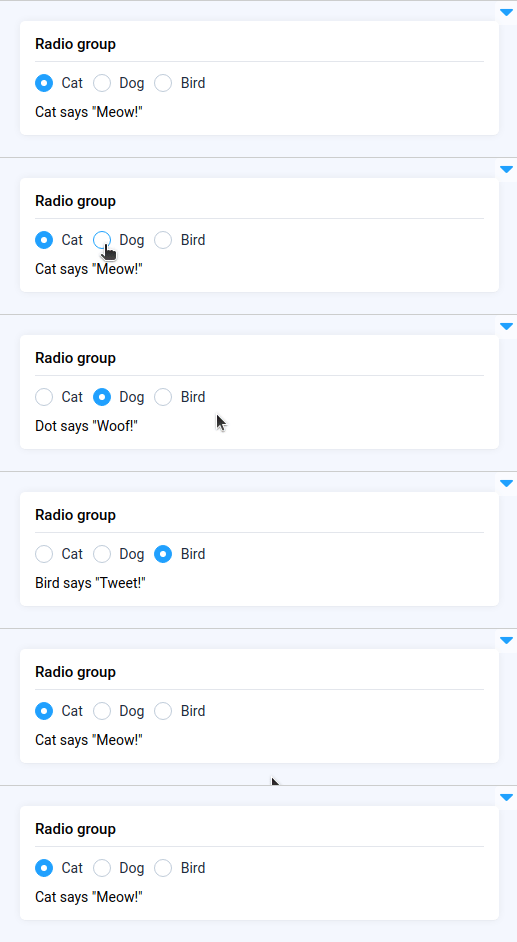
### Initialize `RadioGroup.Item` to use in `RadioGroup`
```python
items=[
RadioGroup.Item(value="cat", label="Cat", content=Text(text='Cat says "Meow!"')),
RadioGroup.Item(value="dog", label="Dog", content=Text(text='Dot says "Woof!"')),
RadioGroup.Item(value="bird", label="Bird", content=Text(text='Bird says "Tweet!"')),
]
```
### Initialize `RadioGroup` widget
```python
radio_group = RadioGroup(items=items, size="large")
```
### Initialize `OneOf` widget to have ability to choose `RadioGroup.Item` content
```python
one_of = OneOf(radio_group)
```
### Create app layout
Prepare a layout for app using `Card` widget with the `content` parameter.
```python
widgets = Container(widgets=[radio_group, one_of])
layout = Card(content=widgets, title="Radio group")
```
### Create app using layout
Create an app object with layout parameter.
```python
app = sly.Application(layout=layout)
```